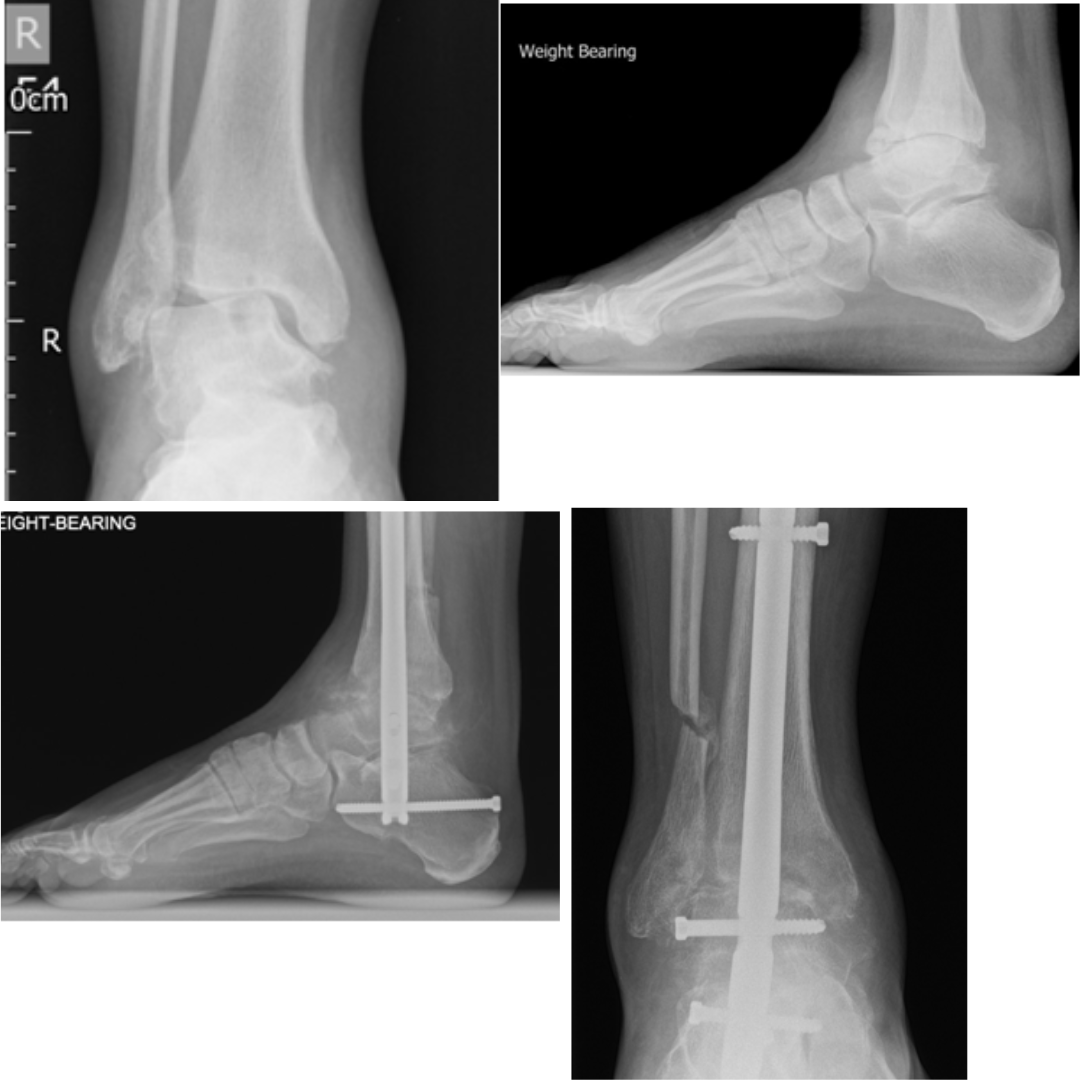
Primary Ankle Arthritis
Primary ankle arthritis is a degenerative condition of the ankle joint cartilage. Patients typically present with pain that is initially activity-related but gradually becomes persistent.
Clinical features
Surgical options
Joint fusion (arthrodesis)
This operation permanently stiffens the painful joint by removing the damaged cartilage and allowing the bones to heal together. It reliably relieves pain but sacrifices joint movement.
Ankle replacement (total ankle arthroplasty)
The aim of ankle replacement is to relieve pain while preserving joint movement.
I do not personally perform this procedure; therefore, patients wishing to consider this option will be referred to a specialist colleague for further discussion.
Potential disadvantages of ankle replacement
If the implant fails or wears out, further surgery is required, which may involve either revision replacement or conversion to an ankle fusion.
Secondary Ankle Arthritis with Associated Deformity
Secondary ankle arthritis develops as a consequence of previous injury or abnormal alignment. The deformity may be varus, valgus, or rotational and leads to uneven loading of the joint, resulting in progressive cartilage wear.
This condition is commonly seen following:
Symptoms
Investigations
Treatment options
Early stages
Advanced stages
Management depends on:
Surgical treatment may involve deformity correction (osteotomy), ligament reconstruction, joint fusion, or joint replacement, either alone or in combination, to restore alignment and relieve pain.
Ankle Arthritis Secondary to Instability
Chronic ankle ligament instability leads to abnormal joint loading and progressive cartilage wear, eventually resulting in arthritis. Management depends on the stage of the disease and the severity of symptoms.
Early arthritis
When cartilage damage is limited, the aim is to restore stability and unload the affected joint surface.
These procedures may slow progression of arthritis and improve function.
Moderate arthritis
Restoring alignment and stability is the priority. Treatment is guided by symptom pattern.
Episodic or activity-related symptoms (joint preservation possible):
The goal is to rebalance the ankle and delay joint-sacrificing surgery.
Severe arthritis
Patients typically have constant pain, limited walking tolerance and disturbed sleep.
At this stage, joint preservation procedures are unlikely to be beneficial.
Surgical options
This reliably relieves pain by eliminating movement at the arthritic joint while restoring a plantigrade, stable foot.