Tarsal Coalition in Children
What is a Tarsal Coalition?
A tarsal coalition is an abnormal connection between two bones in the foot or ankle. The connection may be:
- Bony (true bone bridge)
- Fibrous (soft tissue bridge)
- Mixed (part bone, part fibrous)
The two most common types are:
- Calcaneo-navicular coalition
- Talo-calcaneal coalition
Calcaneo-Navicular Coalition
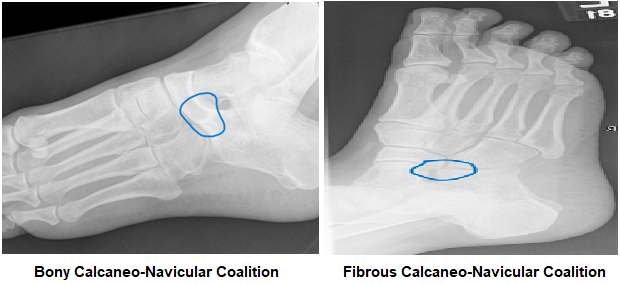
This is the most common type and is often a mixture of bony and fibrous tissue.
Symptoms
Children may develop symptoms as the bones stiffen during growth:
- Stiff foot
- Heel turning inward
- Pain on the outer side of the ankle
- Recurrent ankle sprains or “giving way”
- Painful muscle spasms around the ankle (peroneal spastic foot)
- Activity-related foot pain or deep ankle pain relieved by rest
Investigations
- X-rays — detect bony coalitions
- MRI scan — identifies fibrous coalitions
Treatment
Non-operative treatment
Often tried first, particularly for fibrous coalitions:
- Corrective insoles to improve heel alignment
- Physiotherapy to improve mobility and reduce pain
If symptoms persist, surgery is considered.
Operative Treatment
- Day-case procedure
- Removal (excision) of the coalition, often using keyhole assistance
- Immediate weight-bearing allowed after surgery
- Physiotherapy required for recovery
Talo-Calcaneal Coalition
This usually causes a rigid flat foot.
Symptoms
- Painful flat foot
- Heel pointing outward
- Stiffness of the hindfoot
In:
- Bony coalition → no movement
- Mixed coalition → small amount of movement
Treatment
Non-operative treatment
- Corrective insoles
- Physiotherapy
Operative Treatment
If symptoms continue:
- Day-case keyhole-assisted excision
- Immediate weight-bearing
- Physiotherapy rehabilitation
Can a coalition cause arthritis?
Yes — especially if untreated.
- Calcaneo-navicular coalition
May cause wear of the talo-navicular joint → arthritis and persistent pain in late adolescence or adulthood
- Talo-calcaneal coalition
Initially affects part of the joint, but over time the rest of the joint degenerates → chronic ankle pain not related to activity
- Many children first develop symptoms during late childhood growth
- Insoles and physiotherapy are tried first
- Surgery is considered only if symptoms persist
- Early treatment may reduce the risk of long-term arthritis
Key points for parents
✔ Many children first develop symptoms during late childhood growth
✔ Insoles and physiotherapy are tried first
✔ Surgery is considered only if symptoms persist
✔Early treatment may reduce the risk of long-term arthritis