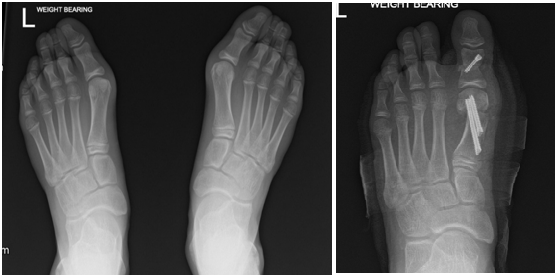
Why do children develop bunions?
There is no single cause for bunions in children. They usually develop due to a combination of factors:
Bunions are more common in girls. This is probably because girls more often have flexible joints combined with flat feet, and footwear choices may also contribute.
Are bunions painful?
In most children, bunions are not painful.
However, the bony prominence on the inner side of the foot can become uncomfortable or painful when:
So the pain usually comes from shoe pressure, not the deformity itself.
Can the progression of bunions be stopped or slowed?
This depends largely on the child’s age and growth stage.
Under 8 years
Growth-guiding surgery (hemiepiphysiodesis) may help by gently correcting the direction of growth of the big toe.
This depends largely on the child’s age and growth stage.
Under 8 years
Growth-guiding surgery (hemiepiphysiodesis) may help by gently correcting the direction of growth of the big toe.
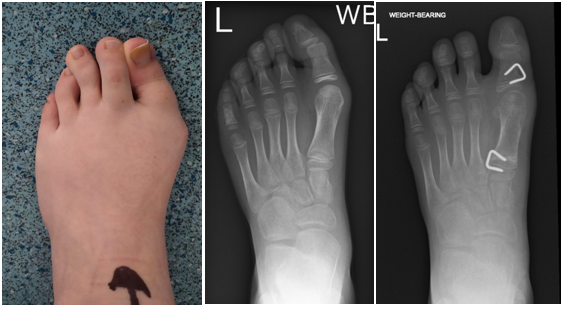
No operation reliably stops progression at this stage.
Treatment focuses on comfort:
12–16 years
Corrective surgery may be considered if symptoms are significant.
However:
Over 16 years
Treatment follows the same principles as adult bunion surgery, with a much lower recurrence risk.