
Diabetes as a Global Epidemic
In the era of the present global pandemic, while the world is slowly struggling back to normalcy, one age-old global pandemic remains unchecked. The prevalence of Diabetes and related conditions is exponentially increasing, and the global health services spend a major chunk of their economy dealing with the complications of this untamed disease.
WHO estimates the global prevalence of this disease is increasing at an alarming rate to 8.5% in 20141, and the International Diabetes Federation reports this prevalence has increased to around 9.3% (463 million people) in 2019 and estimates this to rise to 10.2% (578 million) by 2030 and 10.9% (700 million) by 20452. They also report that the prevalence is higher in urban (10.8%) than rural (7.2%) areas, and in high-income (10.4%) than low-income countries (4.0%). Diabetes is a major cause of blindness, kidney failure, heart attacks, stroke, and lower limb amputation.
Ulceration of the foot is the most common precursor to amputation in Diabetics 3,4, and the incidence of foot ulceration in diabetics with peripheral neuropathy ranges from 19% to 34% 5. From the evidence available, high sugar levels for a prolonged period result in peripheral neuropathy. The International Diabetes Federation report one in two (50.1%) people living with diabetes do not know that they have diabetes2. Within the UK, most of the asymptomatic patients are diagnosed with Diabetes at the 40yrs+ health check-up; but, in those countries where these health checks are not available, the diagnosis of diabetes is delayed, and consequently, patients live with high sugar levels for a long time before the diagnosis is made.
In the epidemiological study by Hicks and Selvin6, the prevalence of peripheral neuropathy in diabetics ranges from 6% to 51%, depending on the population studied. The prevalence is less in Type 1 diabetics, with 6% at baseline, increasing to 30% after 14 years of follow-up, while the baseline prevalence is around 42% in Type 2 diabetics. Most estimates suggest that approximately 50% of adults with diabetes will be affected by diabetic peripheral neuropathy over the course of their lifetime. High uncontrolled blood sugar levels and insulin resistance are believed to result in peripheral neuropathy. Randomised controlled trials demonstrate slowing of the progression of microvascular disease in diabetes, including peripheral neuropathy, with better control of blood sugar levels 7.
Why do Diabetic Foot ulcers develop?
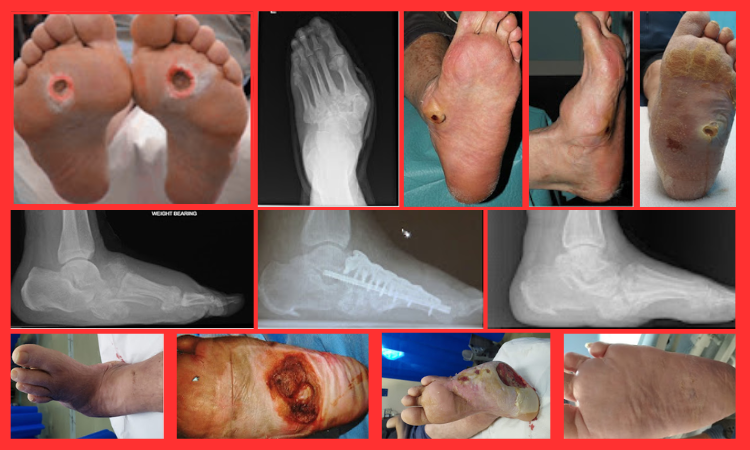
Peripheral neuropathy results in a lack of sensation in the foot; hence, any cause that results in focal increased pressure results in breakdown of skin, resulting in an ulcer. Once the ulcer develops, the microorganisms (bacteria) seep into the soft tissues, resulting in chronic non-healing ulcers. The situation is worsened by the lack of a good blood supply due to fat deposits in the blood vessels that decrease the microcirculation in the foot. A combination of decreased blood supply and bacteria result in infected non-healing ulcers. Soon, the bacteria can spread to the underlying bone, resulting in bony infection. In the presence of poor blood supply, the infection spreads, which ultimately leads to amputation of the leg.
The presence of peripheral neuropathy alone does not result in ulcers. Focal increased pressure, either from faulty footwear or the presence of a foreign body, such as a splinter, stone, or a nail that lodged in the shoe, results in the ulcer- these are external factors.
Internal factors are those that are innate to the human body, such as exostosis (extra bone), abnormal bony pressure following a fracture (Charcot foot), and, most commonly, a deformity of the foot that results in tightness of one of the muscles of the foot.
Can these ulcers be prevented?
Simple answer is YES!!
Ulcers develop over a prolonged period of focal increased pressure. Often these patients self-manage; most present to local podiatric service, where every effort is made to provide accommodative footwear to avoid focal increased pressure. Ulcer development is the end stage of failure of all these collective non-interventional methods.
The most common cause of Diabetic foot ulcer is either an exostosis (bony prominence) or a deformity of the foot as a result of tightness of one of the muscles in the foot.
Ulcers from Exostosis
A simple surgical procedure to shave the extra bone can result in healing of the ulcer within a short period of time. However, prerequisites are adequate blood supply and control of blood sugar levels; hence, assessment by a multidisciplinary group of doctors is essential before surgical intervention.
Some of the patients would need reconstruction of the fracture of the foot before the pressure on the skin is reduced, such as seen in patients with the Charcot foot condition
Ulcers from foot deformities
Ulcers from tight muscles result in characteristic deformities that depend on the muscle that is tight. These deformities are flexible to start with and over a period of time become fixed. When the deformities are flexible, the patients would have thick skin corresponding to the area of increased pressure. If the patient is just treated in an accommodative foot-wear, the pressure on the skin will not progress to an ulcer for a long time; however, the deforming forces remain uncorrected. This, over time, results in fixed deformities, resulting in breakdown of skin over the area where the skin was thick due to increased pressure, resulting in ulceration.
When the foot deformity is flexible, simple tendon lengthening procedures are often adequate to correct the deforming forces, thereby preventing areas of increased focal pressure. When seen at a late stage of fixed deformities, the patient would need major reconstructive surgery to break the bones to correct the deformities, often with more than two operations to control the infection and correct these deformities.
Personal profile and Reasons for these blogs
Mr Madhu Tiruveedhula
Consultant Orthopaedic Surgeon
Basildon Hospital, Basildon
Essex, UK
I am an Orthopaedic consultant who specialises in the treatment of patients with Diabetic foot conditions. I am a part of a multi-disciplinary team based at the Diabetic Foot Unit at Basildon Hospital, Essex, UK.
Through these blogs, I would like to share my experience of why Diabetic foot ulcers happen and how they can be prevented from becoming a cause for amputation. The aim is to enlighten the patients and treating health professionals, and together, we can Say No to Amputation!
References
- Sarwar N, Gao P, Seshasai SR, Gobin R, Kaptoge S, Di Angelantonio et al. Diabetes mellitus, fasting blood glucose concentration, and risk of vascular disease: a collaborative meta-analysis of 102 prospective studies. Emerging Risk Factors Collaboration.Lancet. 2010; 26;375:2215-2222.
- Saeedi P, Petersohn I, Salpea P, et al. Global and regional diabetes prevalence estimates for 2019 and projections for 2030 and 2045: Results from the International Diabetes Federation Diabetes Atlas, 9th edition. Diabetes Res Clin Pract. 2019;157:107843. doi:10.1016/j.diabres.2019.107843
- Quebedeaux TL, Lavery LA, Lavery DC. The development of foot deformities and ulcers after great toe amputation in diabetes. Diabetes Care. 1996;19(2):165-167. doi:10.2337/diacare.19.2.165
- Rosenbloom AL, Silverstein JH, Lezotte DC, Richardson K, McCallum M. Limited joint mobility in childhood diabetes mellitus indicates increased risk for microvascular disease. N Engl J Med. 1981;305(4):191-194. doi:10.1056/NEJM198107233050403
- Margolis DJ, Malay DS, Hoffstad OJ, et al. Economic burden of diabetic foot ulcers and amputations: Data Points #3. In: Data Points Publication Series. Rockville (MD): Agency for Healthcare Research and Quality (US); March 8, 2011.
- Hicks CW, Selvin E. Epidemiology of Peripheral Neuropathy and Lower Extremity Disease in Diabetes. Curr Diab Rep. 2019;19(10):86. Published 2019 Aug 27. doi:10.1007/s11892-019-1212-8
- Ang L, Jaiswal M, Martin C, Pop-Busui R. Glucose control and diabetic neuropathy: lessons from recent large clinical trials. Curr Diab Rep. 2014;14(9):52810.1007/s11892-014-0528-7 [PubMed: 25139473]

